Observability
Part of Workflow error handling
Alerting an owner without creating an alert storm
Make workflow failure alerts actionable, group related records and escalate urgent work without flooding owners.
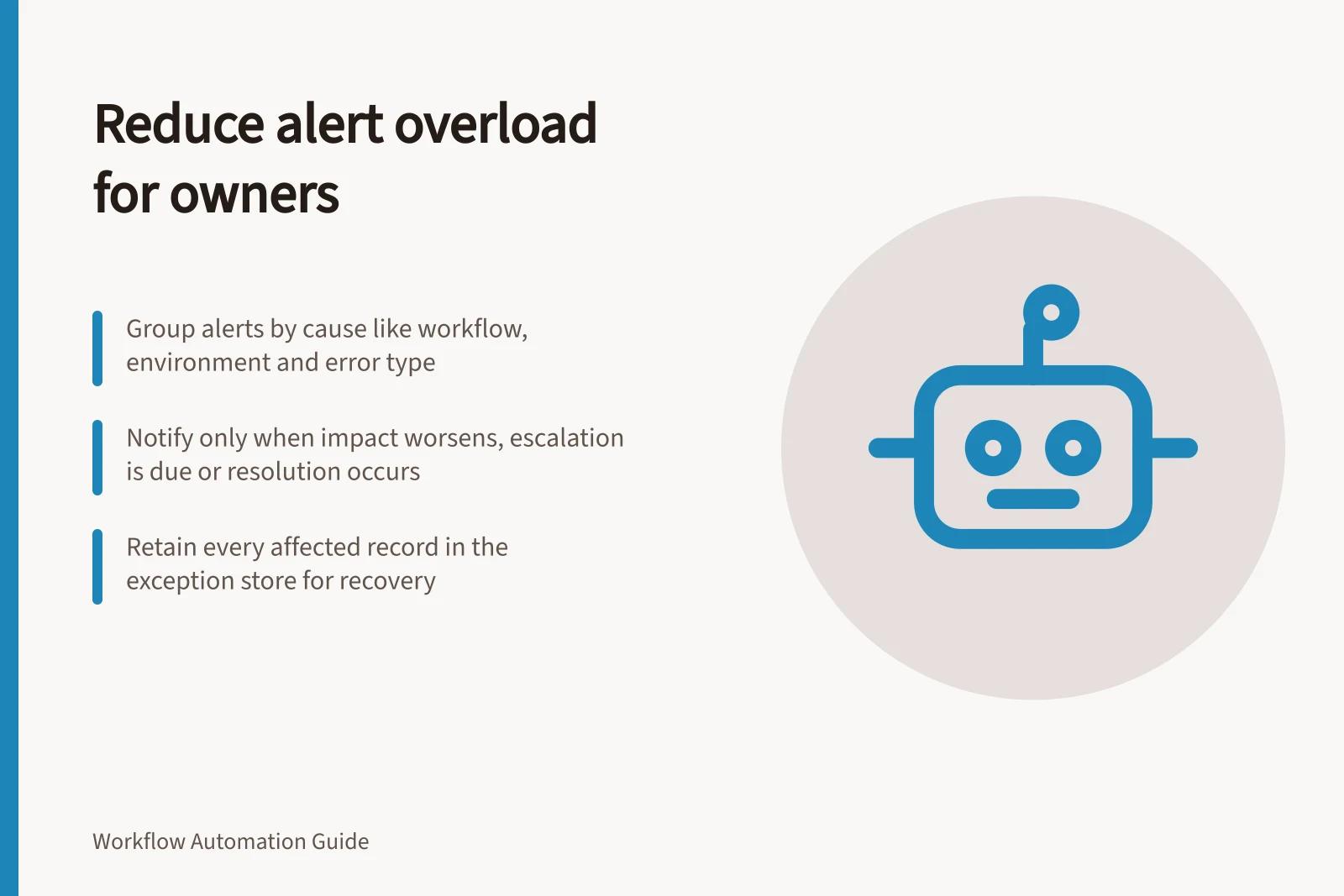
Alert an owner when a workflow failure calls for a decision or threatens a business deadline. Group notifications for records that share a cause, and keep every affected record available for recovery.
A retry that succeeds within its agreed budget usually belongs in the workflow history, not in its own owner notification.
Start with the action and owner
Name who receives the alert and what they can do. Include the outcome at risk, the workflow and dependency involved, the affected-record count, the oldest unresolved item and a route to investigate.
Keep sensitive record details in the controlled work system, not in the notification.
| Condition | Suggested route |
|---|---|
| One invalid record with time to correct it | Create an owned review item in the normal work channel. |
| Several records blocked by one dependency | Notify the integration owner through one incident route and show changing impact. |
| An urgent outcome near its deadline | Escalate through the agreed urgent route, even if a related incident is open. |
| A temporary attempt that recovers within budget | Record the attempt; notify only if its pattern itself needs action. |
These policies are examples. Set response times and escalation from the workflow’s actual business deadline and staffing.
Key Alerting Metrics and Guidelines
- Response Time
- Set against actual business deadline and staffing levels
- Grouping Key Components
- Workflow, destination, environment, error category
- Alertmanager Features
- Deduplication, grouping, routing, inhibition, silences
Group by cause, retain each record
A grouping key might include workflow, destination, environment and error category. Keep record IDs in the exception store; putting each ID in the notification’s grouping key can create one message per failure.
Do not combine distinct causes merely because they occur in the same workflow. An access failure and invalid customer data may need different owners.
Prometheus Alertmanager is one implementation example. It can deduplicate, group and route alerts, and supports inhibition and silences.
Set notification grouping and timing to allow related alerts to be combined without delaying an urgent signal. Choose the timing against the response deadline.
A silence mutes matching notifications; muting a notification does not resolve the underlying work.
Notify on meaningful changes
A useful incident path is new → owner notified → acknowledged → resolved, with escalation if acknowledgement or recovery misses its deadline.
Notify when the condition becomes actionable, impact materially worsens, escalation is due or the incident resolves. Keep the current affected-record count available between messages.
If a dependency outage explains lower-level failures, suppress redundant notifications under a specific rule while preserving their records. Check that an unrelated urgent failure can still reach its owner.
Grouping reduces notification volume; it does not remove the need to work each exception.
Before release, check safe cases for one invalid record, many records sharing a dependency failure, a retry that recovers, a separate urgent failure and an unacknowledged incident. Compare expected recipients and notifications with the actual route, and confirm the owner can reach the affected records.